
Saudi Arabia launches first Middle East biological samples to space
Published AST
Wednesday 14 October 2026
By Markets & Energy Desk
2 min read
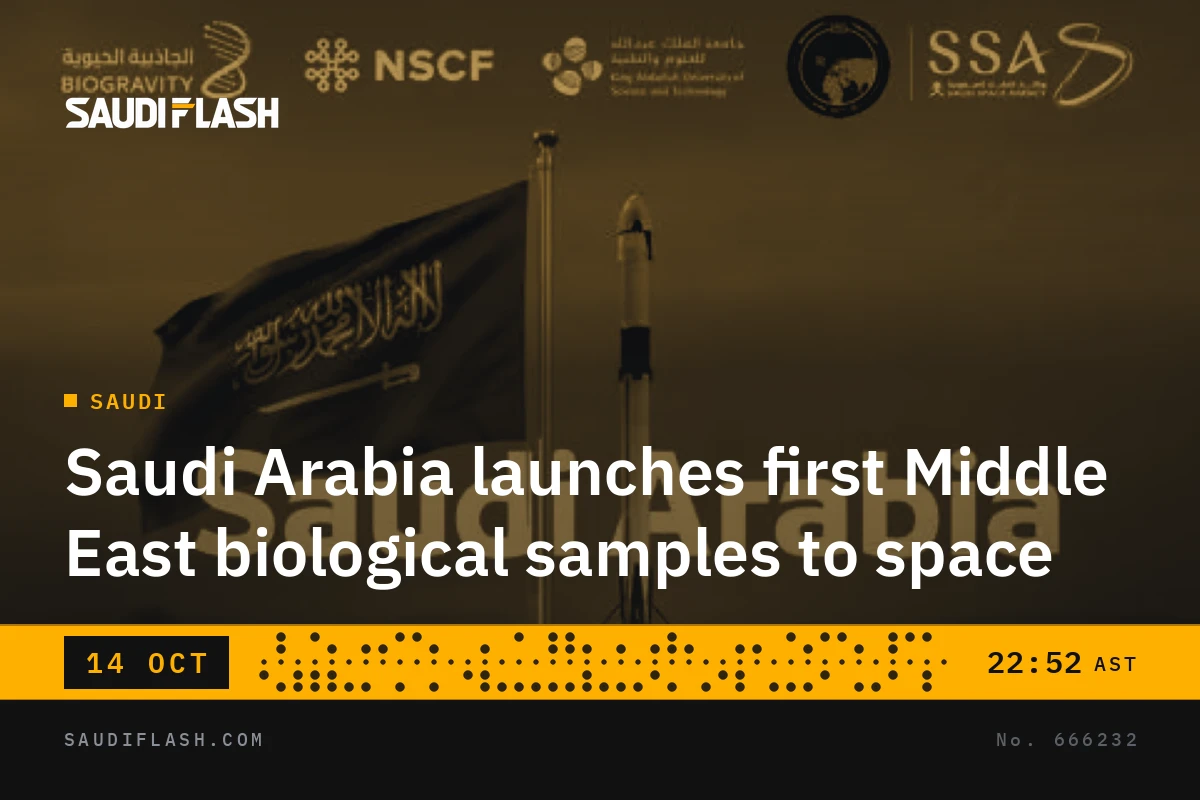
The Saudi Space Agency (SSA) and King Abdullah University of Science and Technology (KAUST) have sent the first biological samples of their kind from the Middle East to space. The samples lifted off aboard the SpaceX CRS-35 mission to the International Space Station as part of the BioGravity-1 programme, with support from NASA.
Mission Overview
The launch is part of a long-term research effort that aims to support scientific work against Alzheimer’s disease and multiple sclerosis across three consecutive missions. The milestone strengthens Saudi Arabia’s role in microgravity research and expands the use of space science and technology in health and life sciences, the SSA said.
Research Objectives
This first phase of the programme sends reference human samples from healthy donors into orbit to establish a scientific baseline for later stages. Researchers will use the unique properties of microgravity to study cellular changes associated with ageing and neurodegenerative diseases. The biological experiments developed by KAUST include two experiments, designated SSA-1 and SSA-2.
The programme is carried out through an international scientific partnership with the US-based National Stem Cell Foundation (NSCF) and Axiom Space, with support from NASA. National participation comes from the SSA and KAUST, connecting Saudi capabilities with the global research community.
Official Statements
Rayyanah Barnawi, General Supervisor of Microgravity Research at the SSA and a Saudi astronaut, said: “The launch of these samples is an important scientific step toward harnessing the space environment to serve human health, and reflects the growth and readiness of national capabilities to take part in advanced research. Through the BioGravity programme, we aim to turn knowledge gained in orbit into research opportunities that deepen our understanding of diseases and support the development of future therapies.”
Professor Imed Gallouzi, Professor of Bioscience at KAUST and lead scientist of the project, said the mission enables researchers to test disease models in an environment that cannot be replicated on Earth. He added that it strengthens the university’s contribution to discoveries that benefit patients in the Kingdom and around the world.
Dr. Pinar Mesci, Scientific Advisor to the National Stem Cell Foundation and Global Head of Biomanufacturing and Biotechnology at Axiom Space, said: “I am especially excited about this mission, as the NSCF team will test the ‘Brain Organoid Village’ concept in microgravity for the first time. Combining multiple individual cell lines within a single organoid enables population-level studies and makes it possible to run what could be described as clinical trials in a dish.” The mission included samples from Saudi Arabia through the collaboration with the SSA and KAUST.
Future Phases
The BioGravity programme spans three interconnected research missions. The first studies healthy reference samples. The second will examine models derived from patients with Alzheimer’s disease and multiple sclerosis. The third will focus on therapeutic responses and explore potential drug targets in microgravity.
The SSA said the programme is part of its efforts to build national capabilities in microgravity research and life sciences, expand international scientific partnerships, and harness space science and technology for human health. It contributes to a knowledge-based economy, innovation and quality of life in line with Saudi Vision 2030.