GCC Urges Global Terrorist Designation for Houthis and Backs Saudi Security
Call for Terrorist Designation and Regional Solidarity
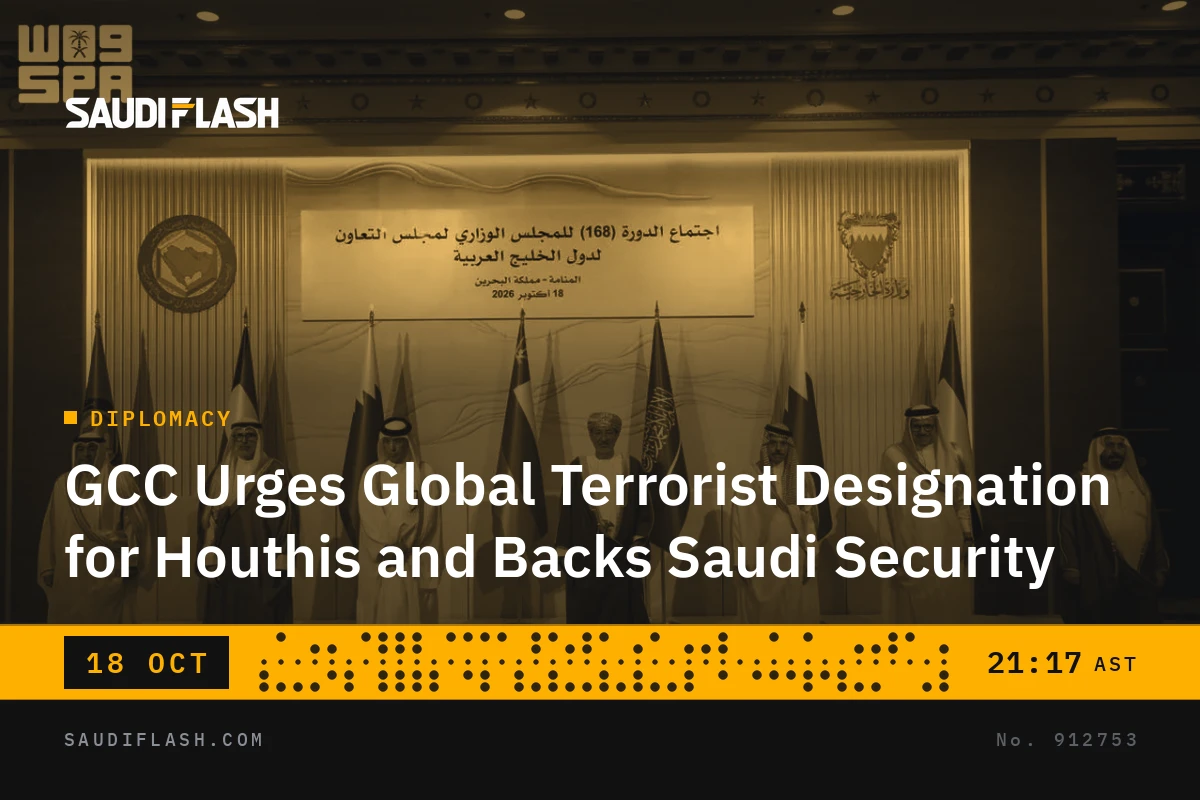
The Gulf Cooperation Council’s Ministerial Council, meeting in Manama on Sunday, urged the international community to designate the Houthi militia as a terrorist group and to treat it like other terrorist organisations that threaten security, peace, development and prosperity.
In its final communique after the 168th session, the council also called for an end to all support that allows the militia to acquire missiles and unmanned aerial vehicles.
Dr. Abdullatif Al Zayani, Bahrain’s foreign minister and chair of the session, presided over the meeting.
Read also: GCC Defence Ministers Approve Advanced Command for Unified Military Command in Kuwait
The council condemned in the strongest terms the repeated Houthi attacks on Saudi Arabia, including strikes on the Two Holy Mosques and surrounding areas, civilian airports and vital facilities, which have caused civilian deaths and injuries and violate international and humanitarian law.
It expressed condolences to the victims’ families and wished a speedy recovery for the injured.
Read also: Saudi Arabia sets new electricity, water and wastewater tariffs from 1 January 2027
The council affirmed the full solidarity of GCC states with Saudi Arabia, their united stance and support for all measures Riyadh takes to protect its sovereignty, security and interests.
It stressed that GCC security is indivisible, that any aggression against one member is aggression against all under the Joint Defense Agreement, and reaffirmed the inherent right to self‑defence, individually and collectively, in line with Article 51 of the UN Charter.
UN Actions and Maritime Security
The council called for implementation of UN Security Council resolutions on Yemen and the Houthi rebellion, including the arms embargo on the militia, and urged the UN and the international community to enforce those resolutions rigorously.
It welcomed the UN Security Council Presidential Statement adopted by consensus on October 15, which condemned the continuing and escalating Houthi attacks on Saudi Arabia — including strikes on Aramco facilities — affirmed Riyadh’s right to self‑defence under international law, condemned attacks and threats against commercial shipping in the Red Sea and Bab Al Mandeb, and stressed full implementation of the arms embargo imposed by Resolution 2216.
Read also: Swedish academic Andreas Malm blocked from entering UK for pro-Palestine event
GCC members reiterated their support for Yemen’s sovereignty, unity and territorial integrity and backed efforts to reach a political solution through dialogue based on the three references: the outcomes of the Comprehensive National Dialogue Conference, the GCC Initiative and relevant UN Security Council resolutions.
The council also condemned continued Iranian missile and drone attacks on GCC states and Jordan, whether direct or via regional proxies, which have hit civilian facilities, public services, residential areas and diplomatic missions, causing material damage and endangering citizens.
It held Iran fully responsible for those attacks, rejected all Iranian justifications, demanded an immediate and unconditional halt to all attacks, provocations and threats, and called for full compliance with UN Security Council Resolution 2817.
The council urged the UN Security Council and the international community to implement the resolution, hold perpetrators accountable and compel Iran to provide full reparation for all damage, in line with UN Human Rights Council Resolution 61/1.
Read also: Saudi Cabinet warns Houthis of accountability for attacks
It affirmed that the Strait of Hormuz, Bab Al Mandeb and the Red Sea are vital waterways whose importance reaches beyond the region, forming major arteries of the global economy, and that securing them and ensuring freedom of navigation is a shared international interest.
The council rejected any attempt to make transit passage conditional on prior approval or imposed routes, noting that such measures would breach the 1982 UN Convention on the Law of the Sea and customary international law.
It called on the International Maritime Organization to continue safeguarding maritime navigation and protecting seafarers, and stressed the need to restore maritime security and freedom of navigation, returning conditions in the Strait of Hormuz to those prevailing before 28 February 2026, in accordance with UNCLOS, the 1982 convention and the Oman‑Iran Agreement on the Delimitation of Maritime Boundaries and the Continental Shelf signed on 25 July 1974, while respecting coastal‑state sovereignty and the rights of concerned states.
Diplomatic Path Forward
Finally, the council advocated a return to dialogue and diplomacy to overcome the crisis, protect regional security and stability and safeguard peoples’ safety, expressing support for mediation efforts by regional and friendly nations aimed at a political solution that avoids further tensions.
It stressed that any understandings must address Iran’s nuclear programme, missile programme, drone activities and support for proxies, grounded in respect for sovereignty, good neighbourliness and non‑interference in internal affairs, and that GCC states must be involved in any negotiations or arrangements affecting their security and interests.